
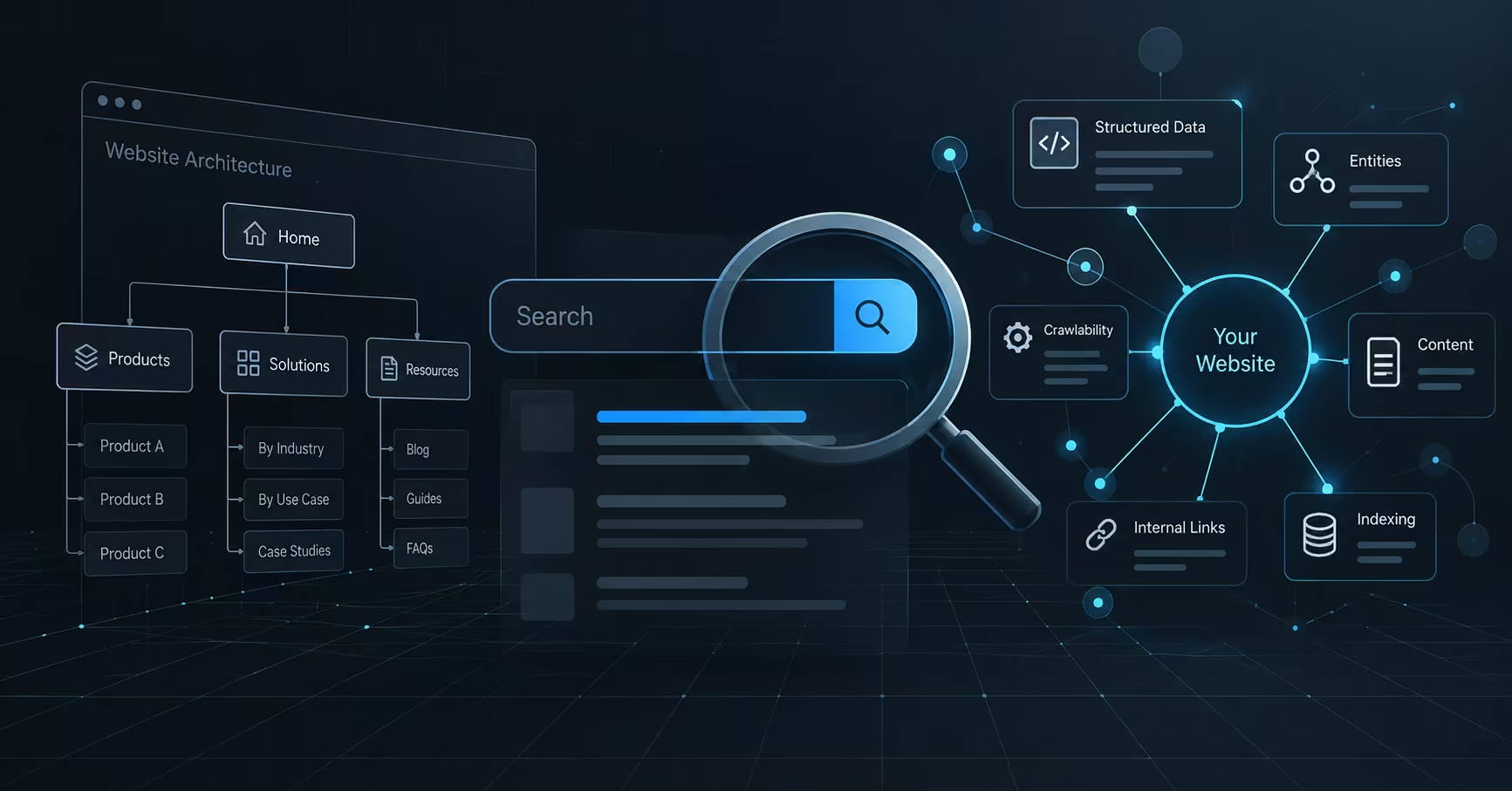
A company can do almost everything right and still be invisible where it matters most. I have seen businesses invest heavily in content, run a consistent SEO program, build legitimate backlinks, and even produce content specifically written with AI Search in mind, and still discover that a large part of their site simply cannot be read, understood, or retrieved by the systems now sitting between them and their customers. The content exists. It just is not technically accessible.
That gap is the subject of this article. Not another list of “AI SEO tricks,” but the technical groundwork that determines whether search engines and AI-powered search systems can discover your site, understand it, trust it, and use it in an answer.
Table of Contents
What Is Technical Optimization for AI Search?
Technical optimization for AI search is the practice of making a website’s infrastructure, code, and markup fully accessible and interpretable to the systems that crawl, index, and retrieve web content, including both traditional search engines and the newer generation of AI-powered answer engines such as Google AI Overviews, Google AI Mode, ChatGPT Search, Perplexity, and Microsoft Copilot.
It is not a separate discipline from technical SEO. It is technical SEO applied with an awareness that more than one type of system is now reading your site, and that these systems do not all behave the same way.
The important distinction here is between two very different things that get talked about as if they were the same: content existing on your website and content being technically discoverable and usable by a retrieval system. A page can be published, indexed by your CMS, and visible to a human visitor while still being invisible to the exact systems you are trying to reach.
Why Traditional Technical SEO Still Matters
I want to be direct about something, because a lot of content in this space implies otherwise: traditional search has not disappeared, and technical SEO has not become obsolete. Google’s own documentation on AI features states plainly that there are no additional technical requirements to appear in AI Overviews or AI Mode beyond the standard Search technical requirements. A page must already be indexed and eligible to appear with a snippet in classic Search before it can be considered as a supporting link in an AI-generated answer.
That single fact reframes the whole conversation. AI Overviews and AI Mode are not a parallel index with their own rules. They draw from the same web index and are evaluated using the same quality systems, including the same E-E-A-T signals, that govern regular organic Search. Google has also described both features as using a “query fan-out” technique, breaking a single question into several related searches to assemble a fuller answer, which is a retrieval behavior built on top of the existing index, not a replacement for it.
The practical takeaway for a business owner is this: fixing crawlability, indexing, and site structure problems is not “old SEO” that you can skip in favor of AI-specific tactics. It is the prerequisite for AI-specific tactics to have anything to work with.
Technical Optimization for AI Search
1. Make Your Website Crawlable
What is it? Crawlability is whether search engines and AI crawlers are technically permitted and able to access your pages at all.
Why does it matter? If a crawler cannot reach a page, nothing else about that page (content quality, keywords, structured data) matters. It cannot be evaluated, indexed, or cited.
What can go wrong? The most common issue I see is accidental blocking: a robots.txt rule left over from a staging environment, a CDN or web application firewall (WAF) rule that silently blocks bots by user agent, or a bot-management tool configured to challenge or reject anything that looks automated, including legitimate search and AI crawlers. This is where many businesses make a mistake: they check robots.txt, see that it allows crawling, and assume the job is done, without realizing their CDN or WAF is blocking the same crawler at a different layer entirely.
It is worth being specific about which crawlers exist. Google’s Googlebot handles regular Search and AI Overviews. Google-Extended is a separate signal specifically for Gemini and AI training use. OpenAI operates three distinct agents: GPTBot (training), OAI-SearchBot (the one that actually determines ChatGPT Search eligibility), and ChatGPT-User (a live, single-page fetch triggered by a user’s in-conversation action). Anthropic operates ClaudeBot. Perplexity operates PerplexityBot for indexing and Perplexity-User for live retrieval. These are not interchangeable, and blocking one does not block the others.
What should the business owner do? Allowing every AI crawler is not automatically the correct business decision, and I want to push back on advice that treats “allow everything” as a default. There are legitimate reasons to restrict some crawlers: content licensing concerns, bandwidth costs on very large sites, protecting content you have no interest in being summarized elsewhere, or simply a business decision that certain crawlers provide no value in return. What matters is that the decision is deliberate, not accidental.
What should business owner ask SEO or development team? “Can you confirm, using our actual server logs, which search and AI crawlers are successfully reaching our site, and which are being blocked at the robots.txt, CDN, or WAF level, and was that intentional?”
2. Fix Indexability Problems
What is it? Indexability is whether a page that has been crawled is actually eligible to be stored and returned by a search system, separate from whether it can be crawled at all.
Why does it matter? If important content cannot reliably be discovered and indexed, it becomes much harder for search systems to use that information, no matter how good the content is or how well it is written.
What can go wrong? A stray noindex tag left in a page template. Canonical tags pointing to the wrong URL, which tells search engines “index this other page instead.” Duplicate or thin content that gets consolidated or dropped. Orphan pages with no internal links pointing to them, which crawlers may never discover in the first place. Faceted navigation and URL parameters generating thousands of near-duplicate URLs that dilute crawl budget and confuse indexing signals.
I would avoid claiming that every AI system follows Google’s exact indexing process, because that is not documented anywhere. What we do know, from Google’s own guidance, is that Google indexing is a prerequisite for appearing in Google’s AI features specifically. Other AI platforms run their own retrieval pipelines with different mechanics, though the underlying principle (a system cannot use content it has not reliably captured) holds across all of them.
What should the business owner do? Periodically check which pages are actually indexed versus which pages you believe should be indexed, and investigate any gap.
What should business owner ask SEO or development team? “Which of our priority pages are excluded from the index, and what is the specific reason for each one?”
3. Build a Clear Website Architecture
What is it? Website architecture is how your pages are organized into categories, hierarchies, and relationships, and how internal links connect them.
Why does it matter? Architecture is how search and retrieval systems infer relationships between your company, your people, your products, your services, and the topics you cover. A flat, disorganized site makes those relationships hard to infer. A logical structure makes them explicit.
What can go wrong? I see this constantly with service-based businesses: a strong homepage, a handful of service pages, and no supporting content connecting them into a coherent topical structure. There is no hub page tying related services together, no clear path from a general topic to the specific page that answers a narrower question, and click depth on important pages is five or six clicks from the homepage.
What should the business owner do? Group related content into clear hubs, use breadcrumbs, and make sure no important page requires more than two or three clicks from the homepage.
What should business owner ask SEO or development team? “Can you map our current site architecture and flag any priority page that is more than three clicks deep or has no clear parent category?”
4. Make Important Content Renderable and Accessible
What is it? This is about whether the content that appears in a browser after JavaScript runs is the same content a crawler receives when it requests the raw page.
Why does it matter? This is, in my view, the single most underappreciated technical issue in AI Search right now, and it deserves more attention than it typically gets. Independent analysis of hundreds of millions of crawl requests (a joint study by Vercel and MERJ) found no evidence that GPTBot, ClaudeBot, or PerplexityBot execute JavaScript. These crawlers occasionally download JavaScript files but do not run them. They receive whatever HTML your server returns immediately, and nothing more. Googlebot and Applebot are the notable exceptions, because they use browser-based rendering infrastructure to render pages before evaluating them.
What can go wrong? A site built as a client-side-rendered single-page application (common with certain React, Vue, or Angular setups) can rank reasonably well on Google, because Google renders the JavaScript, while being functionally blank to ChatGPT, Claude, and Perplexity’s crawlers, because they do not. The practical result: a business can rank on Google and still be effectively absent from AI-generated answers on other platforms, for a reason that has nothing to do with content quality.
What should the business owner do? Verify that your most important content (pricing, product specifications, comparisons, FAQs, service descriptions) is present in the initial HTML response, not injected afterward by JavaScript. Server-side rendering, static site generation, or pre-rendering are the standard fixes.
What should they ask their SEO or development team? “If we disable JavaScript entirely and view the raw HTML source of our five most important pages, is our core content still there?” This is a test any technical team can run in minutes, and I would treat a “no” answer as a priority-one problem, not a nice-to-have fix.
5. Implement Structured Data Correctly
What is it? Structured data, most commonly implemented as JSON-LD, is a standardized machine-readable format (Schema.org) that describes what a piece of content actually is: an article, a product, an organization, a review, a local business, and so on.
Why does it matter? Structured data gives search and retrieval systems explicit, unambiguous context about your content and your entities, reducing the amount of guessing a system has to do.
What can go wrong? This is where I need to be very clear, because a lot of content circulating online overstates what schema markup does. Google has stated repeatedly, including public comments from Search Advocate John Mueller, that structured data is not a ranking factor. It does not guarantee rich results, it does not guarantee AI citations, and adding more of it does not move you up any results page. Google’s own AI features documentation is explicit that no special schema is required to appear in AI Overviews or AI Mode. What structured data actually does is create eligibility for certain search features and give machine-readable context that can help a system interpret and verify your content, when that markup accurately reflects what is visibly on the page.
Markup that does not match visible content, or that is used to imply something the page does not actually say, creates a mismatch that can cause a manual action on rich-result eligibility, and more importantly, can actively work against you if an AI system cross-checks your structured data against your visible text and finds them inconsistent.
What should the business owner do? Use structured data for what it is genuinely useful for: Organization, Person, Product, Service, LocalBusiness, Review, Article, BreadcrumbList, and FAQPage where each of these accurately describes real, visible content. Validate implementations and re-check them after any redesign or template change.
What should business owner ask SEO or development team? “Does our structured data validate without errors, and does every field in it match something a visitor can actually see on the page?”
6. Strengthen Entity Understanding
What is it? Entity understanding is how clearly a search or AI system can identify who you are, what you do, where you operate, who your experts are, and how your organization, your people, and your content relate to one another.
Why does it matter? Search and AI systems increasingly reason about the web in terms of entities (organizations, people, products, places) and the relationships between them, rather than isolated keywords on isolated pages. Ambiguity about who wrote something, who is behind a business, or what a company actually does makes it harder for any system, human or machine, to trust and use that content.
What can go wrong? Inconsistent business name, address, and description across the website and external profiles. Content published with no visible author. Expert team members with no dedicated profile connecting them to their credentials and published work. An “About” page that is vague marketing copy rather than a clear, factual description of the organization.
What should the business owner do? Build out Organization and Person schema, maintain a genuine About page, and give key experts author pages that consistently link their name to their credentials and their published content across the site.
What should business owner ask SEO or development team? “Is our Organization and author information consistent across our website, our Google Business Profile, and the other places our business is listed online?”
7. Build Strong Internal Linking
What is it? Internal linking is the network of links connecting pages within your own site.
Why does it matter? From a technical SEO perspective, internal linking used to be discussed almost entirely in terms of PageRank distribution. That is still relevant, but the more important function for AI Search is discovery and context: contextual internal links help systems understand which pages support a claim, which pages are related, and which pages belong to the same topic cluster.
What can go wrong? Orphan pages with no internal links. Navigation-only linking with no contextual links inside body content. Important supporting pages (case studies, technical documentation, evidence for claims) that are never linked from the pages making those claims.
What should the business owner do? When you make a specific claim or reference a related topic, link to the page that supports or expands on it. Build content hubs where a central page links out to, and receives links back from, its supporting pages.
What should business owner ask SEO or development team? “Do our most important pages have a reasonable number of relevant internal links pointing to them from related content?”
8. Fix Canonicalization and Duplicate Content
What is it? Canonicalization is how you tell search engines which version of a URL is the “real” one when multiple URLs could technically show the same or similar content.
Why does it matter? Inconsistent URL signals (HTTP versus HTTPS, www versus non-www, trailing slash versus no trailing slash, URL parameters) can create ambiguity about which version of a page should be indexed, diluting signals that would otherwise be consolidated onto a single, strong URL.
What can go wrong? A site accessible at four different URL variants with no canonical tags or redirects tying them together. Syndicated content with no canonical pointing back to the original.
What should the business owner do? Pick one canonical version of every URL pattern, redirect all variants to it, and use canonical tags consistently.
What should business owner ask SEO or development team? “Can our site be reached at more than one URL variant for the same page, and if so, are those variants properly redirected or canonicalized?”
9. Improve Website Performance
What is it? Core Web Vitals (Largest Contentful Paint, Interaction to Next Paint, and Cumulative Layout Shift) measure loading speed, responsiveness, and visual stability from a user’s perspective.
Why does it matter? I want to draw an important distinction here, because I have seen this oversold: do not assume Core Web Vitals directly determine whether an AI system will cite your website. There is no documented evidence of that direct link. What Core Web Vitals do affect is overall website quality, user experience, crawl efficiency (a slow, heavy site is harder to crawl thoroughly), and general search performance, all of which indirectly support the conditions that make a page more likely to be indexed well and treated as reliable.
What can go wrong? Unoptimized images, excessive third-party scripts, poor server response times, and render-blocking resources that slow down both human visitors and crawl efficiency.
What should the business owner do? Treat performance as a technical health and user experience priority, not an AI Search shortcut.
What should business owner ask SEO or development team? “What are our current Core Web Vitals scores on our most important pages, and what is the single biggest contributor to any failing scores?”
10. Make the Website Mobile-Friendly and Accessible
What is it? This covers responsive design, semantic HTML, meaningful heading structure, descriptive alt text, and general accessibility practices.
Why does it matter? Human accessibility and machine-readable structure often reinforce each other. A page with a logical heading hierarchy, descriptive link text, and properly labeled images is easier for a screen reader to interpret, and it is also easier for a text-extraction-based AI crawler to parse correctly.
What can go wrong? Heading tags used purely for visual styling rather than actual document structure, images with no alt text carrying essential information, and interactive elements (tabs, accordions, carousels) that hide content in a way that is not accessible to assistive technology or simple text extraction.
What should the business owner do? Use headings to reflect actual content hierarchy, write descriptive alt text for meaningful images, and avoid hiding important content behind interactions that depend on JavaScript execution.
What should business owner ask SEO or development team? “Is our heading structure logical and semantic, and is any critical information hidden inside a tab, accordion, or carousel that requires a click to reveal?”
11. Fix Technical Errors and Technical Debt
What is it? This covers HTTP status codes: broken links returning 404s, pages that should redirect but return errors, redirect chains and loops, and server errors (500-series) that intermittently fail to serve a page.
Why does it matter? Every broken link or redirect chain a crawler encounters wastes crawl budget and signals technical neglect. Server errors during a crawl attempt can cause a page to be dropped from consideration entirely.
What can go wrong? This is especially common after a site migration or redesign: URLs change, redirects are set up incompletely, and months later a meaningful percentage of internal links still point to old, now-broken URLs.
What should the business owner do? Run a full site crawl after any migration and fix broken internal links and redirect chains rather than letting them accumulate.
What should business owner ask SEO or development team? “When was the last full crawl audit of broken links, redirect chains, and server errors, and what did it find?”
12. Keep Important Content Fresh
What is it? Content freshness means keeping factual information, statistics, product details, and references genuinely current.
Why does it matter? Outdated statistics, discontinued products still listed as current, and broken external references all reduce the practical usefulness and trustworthiness of a page.
What can go wrong? I want to be direct about a bad practice I still see recommended: changing a publication date to make a page appear fresh without making a genuine update. This does not create real value, and it is the kind of thing that damages trust when discovered. Focus on meaningful maintenance: updating statistics, correcting outdated claims, and removing dead references.
What should the business owner do? Schedule periodic content reviews of your most important pages, focused on factual accuracy rather than cosmetic date changes.
What should business owner ask SEO or development team? “When was our most important content last reviewed for factual accuracy, not just republished?”
13. Protect Website Security and Trust
What is it? This covers HTTPS, secure hosting, and protection against malware, spam injection, and site compromise.
Why does it matter? A hacked page, injected spam links, or a security warning damages user trust immediately and can affect how search systems evaluate the site more broadly.
What can go wrong? An outdated CMS plugin left unpatched, leading to a compromised site serving spam content or malicious redirects to some visitors while appearing normal to others, sometimes for weeks before discovery.
What should the business owner do? Keep your CMS, plugins, and server software patched, use HTTPS everywhere, and monitor for unexpected changes.
What should business owner ask SEO or development team? “Do we have monitoring in place that would alert us to unauthorized changes or malware injection?”
14. Develop a Deliberate AI Crawler Strategy
What is it? This is the decision, made deliberately rather than by default, about which AI crawlers you allow, which you restrict, and why.
Why does it matter? Allowing every AI crawler is not automatically the correct business decision, and blocking every AI crawler out of caution is not automatically the safest one either. Both are simplifications. The right approach depends on your content strategy, licensing preferences, bandwidth, and business goals.
What can go wrong? A business blocks GPTBot out of general caution about AI training, without realizing GPTBot has nothing to do with ChatGPT Search eligibility, and OAI-SearchBot (the crawler that actually matters for that) was never addressed. This is a genuinely common and understandable mistake, because the naming is not intuitive.
What should the business owner do? Decide separately, and explicitly, whether you want to be included in AI model training versus whether you want to be retrievable and cited in AI-generated answers. These are different questions with different crawlers behind them, and treating them as one decision is a common source of confusion.
What should business owner ask SEO or development team? “Have we made a deliberate decision about each major AI crawler, or are we relying on default settings we never reviewed?”
15. Monitor AI Search Visibility
What is it? This is the ongoing practice of tracking whether, and how, your content appears in AI-generated answers and whether AI crawlers can actually reach your site.
Why does it matter? AI platforms currently expose far less visibility telemetry than traditional search engines do. There is no universal equivalent of Search Console impressions and rankings for every AI platform.
What can currently be measured: Google Search Console and Bing Webmaster Tools remain reliable for indexing status, crawl activity, and (for Bing, as of a February 2026 dashboard update) some direct citation data for Copilot. Server log analysis can confirm whether specific AI crawlers are actually reaching your site and which pages they request. Manual query testing across platforms (asking ChatGPT, Perplexity, and Copilot relevant questions and checking whether and how your site is cited) is a valid, if labor-intensive, practice. A growing category of third-party AI-visibility tools attempts to automate this manual testing at scale.
What remains difficult or impossible to measure reliably: There is no comprehensive, official reporting dashboard across every AI platform equivalent to Search Console. Referral traffic from AI platforms is often undercounted or misattributed in standard analytics. Because these systems are non-deterministic, the same query can return different sources on different occasions, making single-point manual checks unreliable as a trend indicator.
What should the business owner do? Combine what you can verify (indexing status, crawler access via logs, Bing’s citation dashboard where available) with periodic manual testing, and treat single observations with appropriate skepticism rather than as settled fact.
What should business owner ask SEO or development team? “What can we actually verify about our AI Search visibility right now, versus what are we inferring or guessing?”
What Business Owners Should Prioritize First
Start with the fundamentals before investing in advanced tactics. I would organize the work into three tiers.
Priority 1: Critical blockers
These are the issues that make a site invisible outright, and they should be fixed before anything else is worth doing: robots.txt accidentally blocking important pages or resources, unintentional noindex tags, major server errors, content that is completely inaccessible because it depends entirely on client-side JavaScript, incorrect canonicalization pointing away from the real page, and unresolved problems left over from a past migration.
Priority 2: Structural improvements
Once the site is reliably crawlable and indexable, focus on site architecture, internal linking, accurate structured data, entity clarity, and clean XML sitemaps.
Priority 3: Optimization and monitoring
Core Web Vitals, more advanced structured data coverage, ongoing content maintenance, AI visibility monitoring, and regular technical audits belong here, not first.
AI Search Technical Readiness Checklist
Crawlability
- robots.txt allows access to all pages and resources you want discovered
- CDN and WAF settings do not silently block Googlebot, Bingbot, OAI-SearchBot, ClaudeBot, or PerplexityBot
- A deliberate decision has been made and documented for each major AI crawler (allow or restrict, and why)
- No important content sits behind an unnecessary login wall
- Server logs are reviewed periodically to confirm which crawlers actually reach the site
Indexability
- No unintended noindex tags on important pages
- Canonical tags point to the correct, intended version of each page
- No orphan pages among priority content
- Faceted navigation and URL parameters do not generate uncontrolled duplicate URLs
- Indexed page count is periodically compared against the list of pages that should be indexed
Website Architecture
- Priority pages are reachable within two to three clicks from the homepage
- Related content is grouped into clear topical hubs
- Breadcrumb navigation reflects actual site hierarchy
Rendering
- Core content on priority pages is present in the raw HTML with JavaScript disabled
- Pricing, specifications, FAQs, and comparison content do not depend solely on client-side rendering
- Server-side rendering, static generation, or pre-rendering is used where client-side frameworks are in place
Structured Data
- JSON-LD structured data validates without errors
- Every structured data field matches something visible on the page
- Organization, Person, Product, Service, or LocalBusiness schema is implemented where genuinely applicable
- Structured data is reviewed after every major redesign or template change
Entity Clarity
- Business name, address, and description are consistent across the site and external profiles
- Important content has a visible, named author
- Key experts have author or profile pages linking their name, credentials, and published work
- The About page describes the organization factually, not only promotionally
Internal Linking
- Important pages receive contextual internal links, not just navigation links
- Claims made in content link to supporting evidence or related pages elsewhere on the site
- No priority page is orphaned with zero internal links pointing to it
Performance
- Core Web Vitals are measured on priority pages, not just the homepage
- Images are optimized and appropriately sized
- Unnecessary third-party scripts are audited and reduced
Accessibility
- Heading tags follow a logical document structure, not just visual styling
- Meaningful images have descriptive alt text
- No essential information is hidden exclusively behind tabs, accordions, or carousels that require interaction
Security
- HTTPS is enforced sitewide
- CMS, plugins, and server software are kept patched and current
- Monitoring is in place to detect unauthorized changes or malware injection
Monitoring
- Google Search Console and Bing Webmaster Tools are actively reviewed, not just set up
- XML sitemaps are current, error-free, and submitted to both Google and Bing
- Periodic manual testing is done across AI platforms relevant to the business
- A clear distinction is maintained between what is verified and what is assumed about AI visibility
AI Search Optimization Myths Businesses Should Stop Believing
Myth 1: “There is a special AI SEO meta tag.”
No such tag exists in any official documentation from Google, Bing, or OpenAI. Google’s own guidance states there are no additional technical requirements beyond standard Search eligibility to appear in AI features.
Myth 2: “Schema guarantees ChatGPT citations.”
Structured data can help a system interpret your content accurately, but no platform has documented structured data as a guarantee of citation. Google has been explicit that schema is not a ranking factor and does not guarantee inclusion in AI features.
Myth 3: “Blocking all AI crawlers is always the safest strategy.”
This conflates two separate questions: whether you want your content used for model training, and whether you want to be retrievable and cited in AI-generated answers. Blocking crawlers indiscriminately can remove you from citation opportunities you may actually want.
Myth 4: “Allowing AI crawlers guarantees AI traffic.”
Allowing access is necessary but not sufficient. A crawler can access your content and never cite it, just as Google can crawl a page and never rank it.
Myth 5: “Keyword density determines AI citations.”
There is no documented evidence that keyword frequency drives AI citation behavior. Clarity, accuracy, and structure are far more consistently cited as relevant by both official documentation and independent research.
Myth 6: “Traditional SEO no longer matters.”
Google’s own documentation states the opposite directly: AI Overviews and AI Mode run on the same index and the same quality systems as classic Search. A page must be indexed and eligible for a snippet before it can appear in an AI feature at all.
Myth 7: “Publishing large amounts of AI-generated content guarantees visibility.”
Google’s spam policies explicitly cover scaled content abuse regardless of whether the content was produced by AI, automation, templates, or humans. Volume without genuine value is a documented risk, not a documented advantage.
Myth 8: “Core Web Vitals directly determine AI citations.”
No official platform has documented a direct link between Core Web Vitals scores and AI citation likelihood. Core Web Vitals matter for user experience, crawl efficiency, and overall technical health, which support visibility indirectly.
Myth 9: “There is one universal AI Search ranking factor.”
Google, Bing, OpenAI, and Perplexity operate different systems with different documented mechanics. Treating them as one undifferentiated “AI Search algorithm” oversimplifies a genuinely varied landscape.
Myth 10: “You need a completely different SEO strategy for every AI platform.”
The technical foundation (crawlability, indexability, accurate structured data, renderable content, entity clarity) is largely shared across platforms. What differs is emphasis and measurement, not the underlying groundwork.
FAQs: Technical Optimization for AI Search
What is technical SEO for AI Search?
It is the practice of making a website’s infrastructure, code, and markup accessible and interpretable to both traditional search engines and AI-powered search systems, covering crawlability, indexing, rendering, structured data, and site architecture.
Does technical SEO affect AI Search visibility?
Yes. Google’s own documentation confirms that AI Overviews and AI Mode draw from the same index and eligibility requirements as classic Search, meaning a page must already meet standard technical SEO requirements to be considered.
Should businesses allow AI crawlers?
It depends on business goals. There is no single correct answer for every business. Consider licensing preferences, bandwidth, and whether you want to be included in AI training data, retrievable in AI answers, or both.
Does robots.txt affect AI Search?
Yes, for crawlers that respect it, which includes the major documented crawlers from Google, OpenAI, Anthropic, and Perplexity in most cases. However, OpenAI’s own documentation notes that ChatGPT-User, a user-triggered live fetch, may not fully follow the same rules, since the action originates from a person, not an autonomous crawl.
Does schema markup help AI Search?
It can help systems interpret your content and entities accurately when the markup matches visible content, but it is not a ranking factor and does not guarantee inclusion in AI-generated answers.
Can schema guarantee AI citations?
No. No platform has documented structured data as a guarantee of citation.
Do Core Web Vitals affect AI Search?
There is no documented direct link between Core Web Vitals and AI citation likelihood. They matter for overall site quality, user experience, and crawl efficiency, which support visibility indirectly.
How can I tell whether AI systems can access my website?
Check server logs for requests from known AI crawler user agents, and test whether your important content is present in the raw HTML with JavaScript disabled, since most major AI crawlers do not execute JavaScript.
How can I optimize for Google AI Overviews?
Focus on standard Search technical requirements and helpful, people-first content. Google states there are no additional or special requirements beyond being indexed and snippet-eligible in classic Search.
Does traditional SEO still matter?
Yes. Every major platform’s documented guidance treats technical SEO fundamentals as the foundation AI Search visibility is built on, not a legacy practice being replaced.
How can I monitor AI citations?
Use Google Search Console and Bing Webmaster Tools for indexing and (where available) citation data, review server logs for crawler activity, and periodically test relevant queries manually across AI platforms.
What technical problems can hurt search visibility?
Blocked crawlers, unintentional noindex tags, broken canonicalization, JavaScript-dependent content, orphan pages, slow or unreliable servers, and unresolved migration issues are among the most common and consequential.
Does JavaScript affect AI Search?
Significantly. Independent research analyzing hundreds of millions of crawl requests found that major AI crawlers such as GPTBot, ClaudeBot, and PerplexityBot do not execute JavaScript, meaning content that only appears after client-side rendering can be invisible to them even while ranking normally on Google.
How important is internal linking for AI Search?
Contextual internal linking helps systems discover related pages, understand topic relationships, and locate supporting evidence for claims, beyond its traditional role in distributing authority across a site.
How should businesses approach AI Search?
Start with technical fundamentals: crawlability, indexing, rendering, and accurate structured data. Layer entity clarity and internal linking on top. Treat AI-specific monitoring and advanced tactics as the final stage, not the starting point.
Final Takeaway
If I had to compress this entire article into one sentence, it would be this: AI Search does not reward websites that talk about AI Search, it rewards websites that are technically sound enough for any system, human or machine, to reliably access, understand, and trust. Start there. The advanced tactics only work on top of a technical foundation that actually holds weight.
Author: Sardar Monsur Ahmad
Focus: Technical SEO, AI Search Visibility, Conversion Rate Optimization (CRO).